How it works
Where does your company's knowledge actually live?
Follow one claim. It arrives at 6:02 pm. The rule that decides it lives in one senior's memory — and she's on leave.
The rest of what's needed sits in a 2019 Slack thread, on page 41 of a policy PDF, and in a ticket nobody can find. Every company runs on knowledge like this — scattered, unwritten, and walking out the door at 6 pm. This page follows that one claim, #4517, through the four moves that turn scattered know-how into an operated function.
Claim #4517 · 6:02 pm
Motor — own damage · ₹68,400
Status: waiting — knowledge not found
01–04 · Building the brain
Watch the brain assemble around one claim.
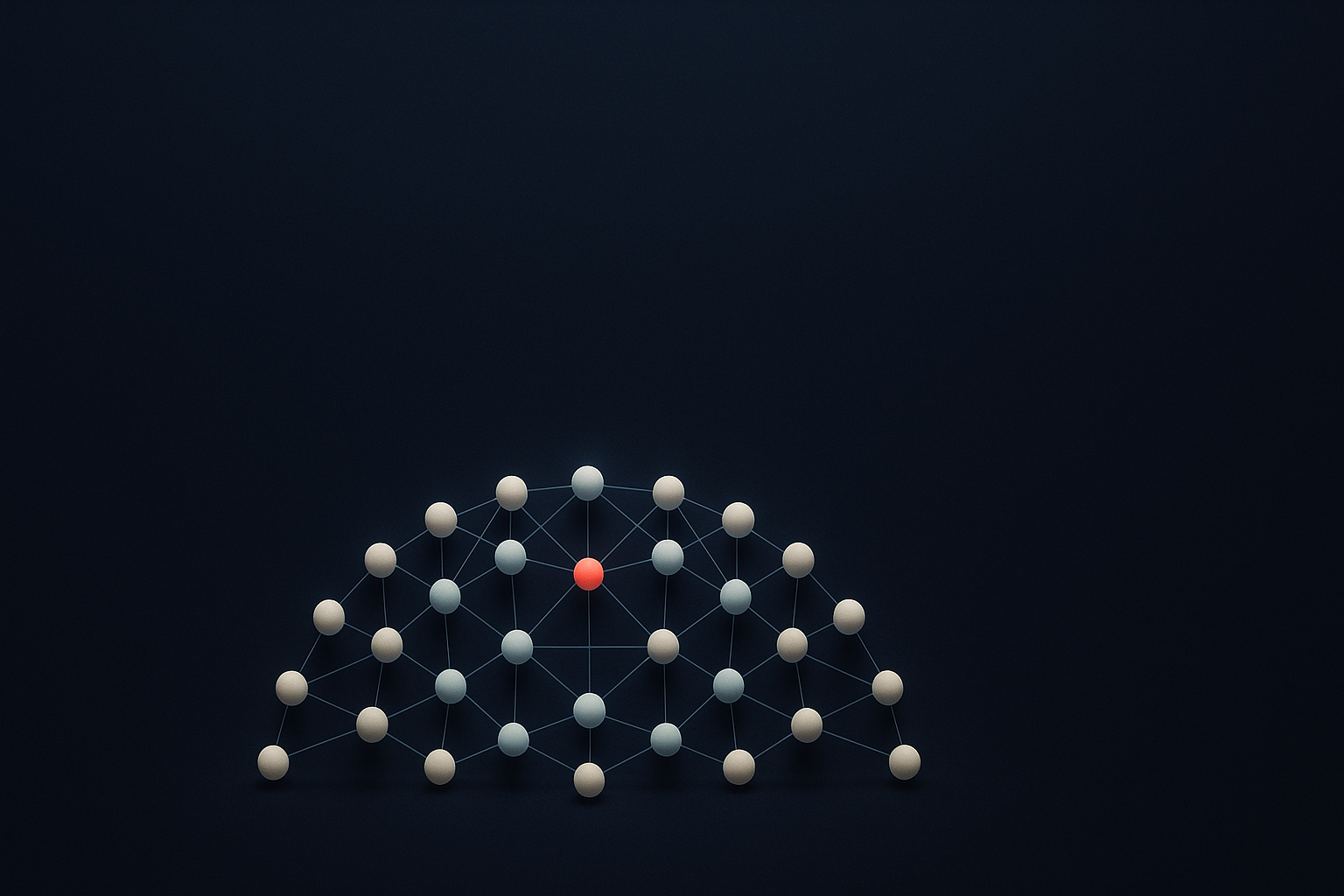
Now watch the same claim enter the brain: the rule is mapped, the decision is executable, the exception has an owner. Scroll — each stage of the build is one move: Map, Structure, Operate, Improve.
01 · Map
Connect the scatter
Connect your systems, tickets, docs and data. We index how the work actually flows today — in days, not months.
Claim #4517's world — the core system, the surveyor's inbox, page 41 of the policy PDF, that 2019 Slack thread — is indexed into one connected map.
02 · Structure
Make it executable
We turn scattered know-how into a living graph and an executable set of rules — how refunds, claims, exceptions and decisions really get made.
The way Priya actually decides — “over ₹5,000 on a vehicle older than 8 years goes to tier-2” — becomes rule R-114: written down, sourced, executable.
03 · Operate
Run the claim
Agents run the function on top of the brain. Routine work is done automatically; edge cases route to a human owner.
Agents take #4517 through pre-inspection and underwriting in minutes. One thing is genuinely unclear — salvage value — so the claim routes to Priya N., who owns the call.
04 · Improve
Close the loop
Every event updates the brain. The function gets faster, cheaper and more accurate over time — and never forgets.
Priya's resolution writes back as a new rule. Claim #4518 hits the same edge and clears it without her — decision time falls from 31 minutes to 4.
05 · Two engines
Zoom out: one brain, two engines.
The claims brain you just watched assemble is one instance of a pattern. At Antino, the same loop powers two engines — one that wins and scopes the work, one that runs and ships it. Both write back to the brain.
win & scope
Revenue OS
A living graph of everything Antino has delivered.
- Capability match — a prospect's need maps to proven capabilities and the exact past projects behind them.
- Proof assembly — the right case studies, outcomes and buyer-fit surfaced automatically.
- Outcome scoping — recommends the scope, team and the outcome to commit to, from comparable engagements.
- Proposal drafting — agents turn the match into a tailored, evidence-backed proposal.
run & ship
Delivery OS
A living graph of how the client's product actually works.
- Product graph — code, tickets, errors and analytics indexed into one map, updated on every event.
- Cited answers — any question about the system answered with sources; no tribal knowledge.
- Specs & triage — incidents pre-triaged, specs grounded in real code, work generated for agents.
- Health & signals — delivery metrics, adoption and competitive gaps watched continuously.
Revenue OS writes back what was promised. Delivery OS writes back what was shipped. The brain reconciles the two — which is why the 241st function starts smarter than the first.
06 · What this is not
Not a copilot. Not a bench. Not a chatbot.
Copilots help your people work — they don't do the work.
Staff augmentation rents you hours, and rebuilds context every time.
Search & chatbots answer questions — they can't run a process.
We build the brain, run the function on it, and own the outcome — the metric we agree to move, named before we start: claims decided in minutes, same-day adjudication, approval in the first session, products shipped and adopted.
07 · Start here
Run one function.
That claim is now decided in minutes — and tomorrow it could be your claim, your member, your onboarding.We map the brain in days, show you the outcome we'd commit to before you commit, and put a named owner on every exception.

FAQ
What people ask about the brain.
A living, executable map of how your work actually gets done — the rules, exceptions, and decisions that today live in people's heads, old tickets, and policy docs — structured so that AI agents can run on it, not just read it.
Days, not months. We connect the systems you already use — tickets, docs, data, communications — and index how the work actually flows today.
They route to a named human owner. Agents do the routine work; every exception, judgment call, or decision with real consequence goes to a person — and their resolution writes back into the brain as a new rule.
The ones where your knowledge already lives: ticketing and project tools, documentation, communication threads, databases, codebases, and analytics. The brain is built from your real artifacts, not workshops.
Yes — that's the point. Every event updates it. Each resolved exception becomes a rule, so the function gets faster, cheaper, and more accurate with every run, and never forgets.
You keep the brain. The encoded knowledge — the map of how your function runs — is yours: documented, structured, and executable.