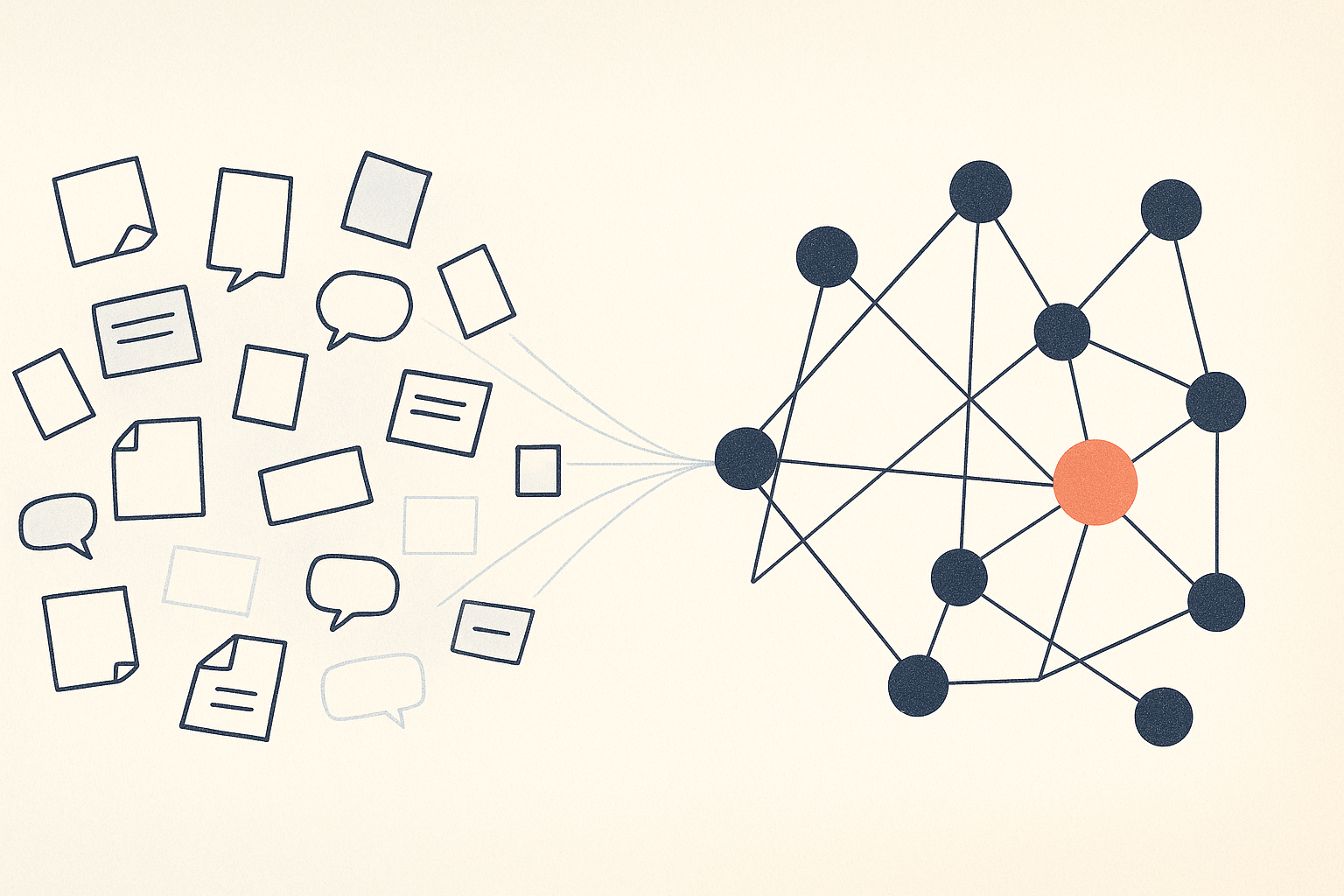
Inside the brain
Every company’s know-how is scattered.
The brain makes it executable.
AI agents can’t run on tribal knowledge. They need a structure: a living, queryable, executable map of how decisions actually get made, how exceptions actually get handled, how the work actually flows. Antino builds that map for a function — the Company Brain — and then runs the function on top of it. You get the outcome, not the headcount.

What the brain encodes
The knowledge that makes your company work — but lives nowhere anyone can find it.
Every organisation runs on accumulated judgment: how edge cases get resolved, who makes which call, what the rule actually is when the policy manual doesn’t cover it. The brain encodes that judgment as structured, executable rules — so an agent can act on it, a manager can audit it, and the organisation never has to start from scratch again.
Right now, that logic lives in someone's head — a senior ops lead who knows that orders over ₹5,000 go to tier-2 review, that gift orders skip the restocking fee, that international transactions need a 48-hour hold. When they leave, that knowledge leaves too. The brain encodes it: a structured rule graph that an agent can execute, an exception can route, and a new hire can read on day one.
A deal comes in 22% below standard rate. Who approves it? Under what conditions? What comparable deals exist? Today, that answer lives in a Slack thread, a VP's memory, and three years of closed-won CRM notes — none of it connected. The brain indexes every past exception, the reason it was granted, and the outcome it produced. The next exception gets a recommended answer and a cited precedent, not a guessing game.
Underwriting rules are part regulation, part actuarial model, part institutional judgment built up over thousands of edge cases. They're in policy manuals, in Confluence pages nobody reads, and in the muscle memory of underwriters who've been there a decade. The brain encodes those rules as executable DMN decision tables — auditable, testable, and runnable by an agent — so every claim gets consistent treatment regardless of who's working that day.
When production goes down at 2 AM, the response depends entirely on who's on call and how long they've been at the company. A veteran knows to check the payment queue first, knows that this class of error traces to a Kafka consumer lag, knows the runbook is outdated and the real fix is in a comment on issue #4821. The brain encodes that institutional memory: indexed error history, annotated runbooks, cited fixes — so the first responder finds the answer in seconds, not after 40 minutes of Slack archaeology.
Every client onboarding follows a path that's partly formal process and partly accumulated scar tissue — the checklist item everyone skips, the integration that always needs a manual fix, the stakeholder who needs to be looped in before kickoff or the whole thing stalls. That knowledge exists in the heads of people who've done it thirty times. The brain makes it executable: a structured onboarding graph that covers every function, routes every exception, and gets sharper with each new engagement.
02 · How it works
Watch a function become a brain.
Four moves take scattered know-how to an operated outcome that gets sharper with every event — Map, Structure, Operate, Improve.
Watch a function become a brain.
Map · Structure · Operate · Improve
One brain, two engines
Two graphs over one shared source of truth.
One engine wins and prices the work. The other runs and ships it. The same accumulated knowledge — encoded in the brain — powers both. And each engine writes new learning back into it. The brain gets sharper with every engagement, every delivery, every exception resolved.
Revenue OS
A living graph of everything Antino has delivered.
- Capability match — a prospect's need maps to proven capabilities and the exact past projects behind them.
- Proof assembly — the right case studies, outcomes and buyer-fit surfaced automatically.
- Outcome scoping — recommends the scope, team and the outcome to commit to, from comparable engagements.
- Proposal drafting — agents turn the match into a tailored, evidence-backed proposal.
Delivery OS
A living graph of how the client's product actually works.
- Product graph — code, tickets, errors and analytics indexed into one map, updated on every event.
- Cited answers — any question about the system answered with sources; no tribal knowledge.
- Specs & triage — incidents pre-triaged, specs grounded in real code, work generated for agents.
- Health & signals — delivery metrics, adoption and competitive gaps watched continuously.

Already operating, not aspiring
The loop already closes.
The portfolio brain already encodes 240 functions into capabilities, proof points, buyer signals, and pricing patterns — a working Revenue OS today. The agentic operating layer already runs delivery on a live product graph. The repositioning connects them; it does not invent them.
Each one contributing capabilities, pricing signals, and proof to the Revenue OS today.
Insurance, healthtech, fintech, mobility — live in production, not in a deck.
Every hour a decision made, an exception resolved, a pattern learned — all writing back to the brain.
“What we learn winning the work informs how we run it. What we learn running it sharpens how we win the next one. The loop closes — and gets tighter every time.”
09 · Run a function
Stop renting hours. Start running functions.
Pick the function you want off your plate. We'll map the brain and name the outcome we'd commit to — before you do.